Unlocking the Secrets of the Solar System: A Visual and Educational Guide
The cosmos has always held a profound fascination for humanity, serving as both a source of scientific inquiry and artistic inspiration. At the heart of our local celestial neighborhood lies the Solar System, a complex and dynamic arrangement of celestial bodies bound by gravity. For educators, designers, astronomy enthusiasts, and students, understanding this system is not merely about memorizing facts; it is about visualizing the intricate dance of planets, moons, and stars. Whether you are creating educational materials for a school curriculum or designing engaging graphics for a science publication, having access to high-quality, accurate representations of the Solar System is essential.
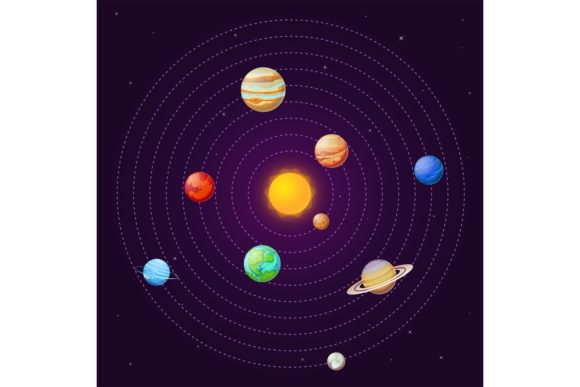
This article explores the significance of visualizing our planetary neighborhood, the challenges involved in accurate representation, and how versatile digital resources can bridge the gap between complex astronomical data and accessible education. By leveraging professional vector assets, such as a cartoon sun and planets on a starry sky background, users can transform abstract concepts into tangible learning experiences.
The Challenge of Visualizing Celestial Mechanics
One of the primary difficulties in teaching or presenting astronomy is the sheer scale and diversity of the Solar System. From the scorching surface of Mercury to the icy winds of Neptune, each planet possesses unique characteristics that define its role in the cosmic ecosystem. Traditional textbooks often rely on static, low-resolution images that fail to capture the vibrancy of these worlds. Furthermore, representing the relative sizes and distances accurately is notoriously difficult in two-dimensional formats. If scaled correctly, the planets would be invisible dots compared to the vast emptiness between them.
Designers and educators face a specific set of needs when addressing this topic. They require visuals that are scientifically recognizable yet aesthetically pleasing. For instance, Jupiter must display its iconic Great Red Spot, while Saturn needs its distinct ring system. Meanwhile, smaller bodies like Pluto, though reclassified as a dwarf planet, remain a crucial part of public interest and historical context within the Solar System. The challenge lies in balancing scientific accuracy with visual clarity, ensuring that viewers can easily distinguish between Venus, Earth, and Mars without needing a telescope.
How Vector Graphics Enhance Astronomy Education
This is where high-quality vector resources become invaluable. A professional Solar System vector background offers a solution that raster images cannot match. Vector graphics, such as those provided in an EPS10 file format, are resolution-independent. This means they can be scaled from the size of a business card to a massive classroom poster without any loss of quality. For educators creating handouts or designers working on large-format displays, this flexibility is critical.
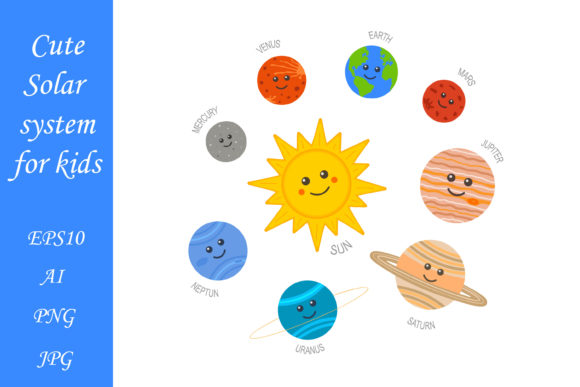
Consider the utility of a file containing a cartoon sun and planets on a starry sky. Such an asset allows for immediate deployment in various contexts. A teacher can project the image onto a smartboard to discuss planetary order, while a graphic designer can isolate individual elements to create infographics about specific planets like Uranus or Neptune. The ability to separate elements using a vector editor like Adobe Illustrator empowers users to customize the content to their specific needs. You might choose to highlight the terrestrial planets—Mercury, Venus, Earth, and Mars—in one lesson, and the gas giants in another.
Practical Applications for Different Users
The versatility of a comprehensive Solar System illustration means it serves a wide array of professionals and hobbyists. Understanding how different groups approach this topic can help maximize the value of such resources.
- Educators and Schools: For teachers, visual aids are crucial for maintaining student engagement. A colorful, vector-based depiction of the Solar System can serve as the foundation for lessons on gravity, orbit, and planetary composition. By removing or editing specific elements, teachers can create quizzes where students must label the planets or identify the correct order from the sun.
- Graphic Designers: Designers working on science-themed projects, such as magazine covers, website banners, or app interfaces, need assets that are easy to integrate. A vector EPS10 file allows for seamless color adjustments to match brand guidelines or thematic requirements. The clean lines and scalable nature of vectors ensure that the final product looks professional on any device.
- Content Creators and Bloggers: In the digital age, visual content drives engagement. Bloggers writing about space exploration, NASA missions, or astronomical events can use these illustrations to break up text and provide visual context. A well-designed graphic of the Solar System can significantly improve readability and shareability on social media platforms.
- Parents and Homeschoolers: For those educating children at home, having access to printable, high-quality materials is a boon. Parents can print out the planets, cut them out, and create interactive models that help children understand the concept of rotation and revolution around the sun.
Navigating the Planetary Lineup
When utilizing these visual resources, it is important to understand the key players in our Solar System. Each planet offers a unique narrative that can be highlighted through design. Mercury, the closest to the sun, is often depicted with a cratered surface reminiscent of our moon. Venus, shrouded in thick clouds, is usually shown in bright yellows and whites. Earth, our blue marble, stands out with its continents and oceans. Mars, the red planet, invites discussions about future colonization and robotic exploration.
Beyond the terrestrial worlds, the gas giants dominate the outer reaches. Jupiter, the largest planet, is a centerpiece of any Solar System illustration, often accompanied by its many moons. Saturn’s rings make it instantly recognizable. Further out, Uranus and Neptune offer cool blue and cyan hues, representing the ice giants. Including Pluto, despite its dwarf planet status, acknowledges its cultural significance and the ongoing debate about planetary classification. A comprehensive vector set ensures all these bodies are represented, allowing for a complete overview of our cosmic neighborhood.
Maximizing Utility with Vector Editing
To truly benefit from a Solar System vector package, users should familiarize themselves with basic vector editing techniques. Since the product file typically comes as one vector EPS10 file, the initial step is to ungroup the elements. This allows you to move the sun, adjust the position of Jupiter, or change the color of the starry sky background. If you want to focus solely on the inner planets, you can simply delete the outer giants. Conversely, if you are creating a presentation on the Kuiper Belt, you can emphasize Pluto and other distant objects.
Recommendations for best practices include maintaining consistent lighting sources when modifying colors and ensuring that text labels, if added, are legible against the background. Using layers in software like Adobe Illustrator can help keep the workspace organized, especially when dealing with complex scenes involving multiple satellites and planetary rings. Remember, the goal is to enhance understanding, so clarity should always take precedence over excessive decorative detail.
Conclusion
The Solar System is more than just a collection of rocks and gas; it is a dynamic system that defines our place in the universe. Whether for educational purposes, professional design, or personal interest, having access to high-quality, editable visual resources is a powerful tool. By utilizing vector graphics that depict the sun, planets, and starry backgrounds, users can create engaging, accurate, and visually appealing content. From the fiery surface of Mercury to the frozen depths of Neptune, every element plays a role in the grand narrative of our cosmic home. Embrace the flexibility of vector editing to tailor these resources to your specific needs, fostering a deeper appreciation and understanding of astronomy for audiences of all ages.